
Blog Posts


Team Trenkwalder
2 months ago
•4 min read
Human ResourcesRecruiting/Flex Employment
Employer of Record:
Building International Teams Without Losing Your Role as an Employer
If you want to hire internationally, you don’t necessarily need to establish your own company in the target country. This assumption persists, even though there are more suitable approaches. Imagine three scenarios: You’ve recruited a highly sought-after specialist in a new market. You’re building a small international team. You’re employing a remote specialist who works abroad on a permanent basis. Do you want to hire international talent without relinquishing day-to-day management control?
This is exactly where the Employer of Record (EOR) comes in. Under this model, your company remains responsible for operational task management and day-to-day management, while the EOR, as the legal employer, handles the administrative, legal, and tax-related tasks.
Why International Hiring Should Be Planned Early
International hiring involves various legal and organizational requirements. Depending on the employee’s country of origin and the employment model, labor law, tax, and social security regulations must be taken into account. The specific requirements therefore depend heavily on the individual case.
Early planning is a basis for decision-making, not a mere formality. Those who address the relevant issues only shortly before work begins risk unnecessary delays. Early planning, on the other hand, ensures that skilled workers are ready to start at the planned time.
This isn’t about abstract bureaucracy. It’s about predictability for your company and a clear, simple journey for international employees. To help you choose the right model, you first need to understand which tasks an EOR actually handles and which remain your responsibility.
What an Employer of Record Handles—and What Remains with the Company
An Employer of Record (EOR) is a model in which a company engages an external provider to act as the legal employer for its employees. The client company retains control over day-to-day operations and management. For example, an EOR manages payroll, tax withholding, social security contributions, and compliance with the labor laws of the respective country.
These responsibilities can be divided into two groups. The EOR is the legal employer. The client company is the operational authority. This classification does not replace comprehensive legal advice, but it does provide a solid foundation for understanding.
Employment contracts, benefits, taxes, and administrative processes must be reviewed based on the target country, the specific employment situation, and the agreed-upon scope of services. We cannot promise blanket coverage of individual services, as the details depend on the specific case.
For internal HR teams, this has a tangible effect: Delegating administrative tasks can free up capacity for employee retention, talent development, and corporate culture. One key point remains consistent throughout this article: EOR does not replace the client company’s operational management responsibility.
Clearly Separating Roles in the EOR Model
The legal employer and the line manager are two separate functions. The EOR is formally named in the employment contract and bears the administrative, legal, and tax obligations in the target country. Your company determines which tasks the individual will perform, how the team works, and what goals apply.
This separation is at the core of the model. You can hire internationally without having to establish your own company in the respective country. Day-to-day management remains entirely in your hands. The EOR ensures that the employment relationship is handled in compliance with the law.
Organizing the Contract, Payroll, and Ongoing HR Administration
The EOR’s role includes the local employment contract, payroll processing, tax withholding, and social security contributions. Compliance with the labor laws of the respective country also falls within this scope. The exact structure of benefits and ongoing administration depends on the target country and the agreed-upon scope of services.
For your HR team, this means focus on structure rather than managing details. Instead of setting up local HR resources and office infrastructure abroad, you have access to a defined service framework. You should transparently agree in advance on what is included in each specific case.
When EOR, an In-House Company, or Other Models Are Appropriate
The choice of model is a situational assessment, not a blanket comparison. A new market, a single international specialist, a temporarily expanding team, or the long-term establishment of a location each lead to different answers. The specific scenario is the deciding factor.
Recruitment and EOR address different needs. Recruitment supports the search and selection process. Trenkwalder handles the search, selection, and screening of suitable candidates. EOR pertains to the legal role of the employer and employment administration following selection.
Temporary staffing should not be equated with EOR. Both models follow different operational logics and must be evaluated based on the specific country, the job, and the desired employer role. Contractor or freelancing models are a separate form of contract, and their assessment under tax and labor law always depends on the individual case.
The EOR is often relevant for the option that does not require a company of one’s own. Models such as EOR make it possible to deploy international professionals without having to establish a company in the respective country, while the company retains professional leadership.
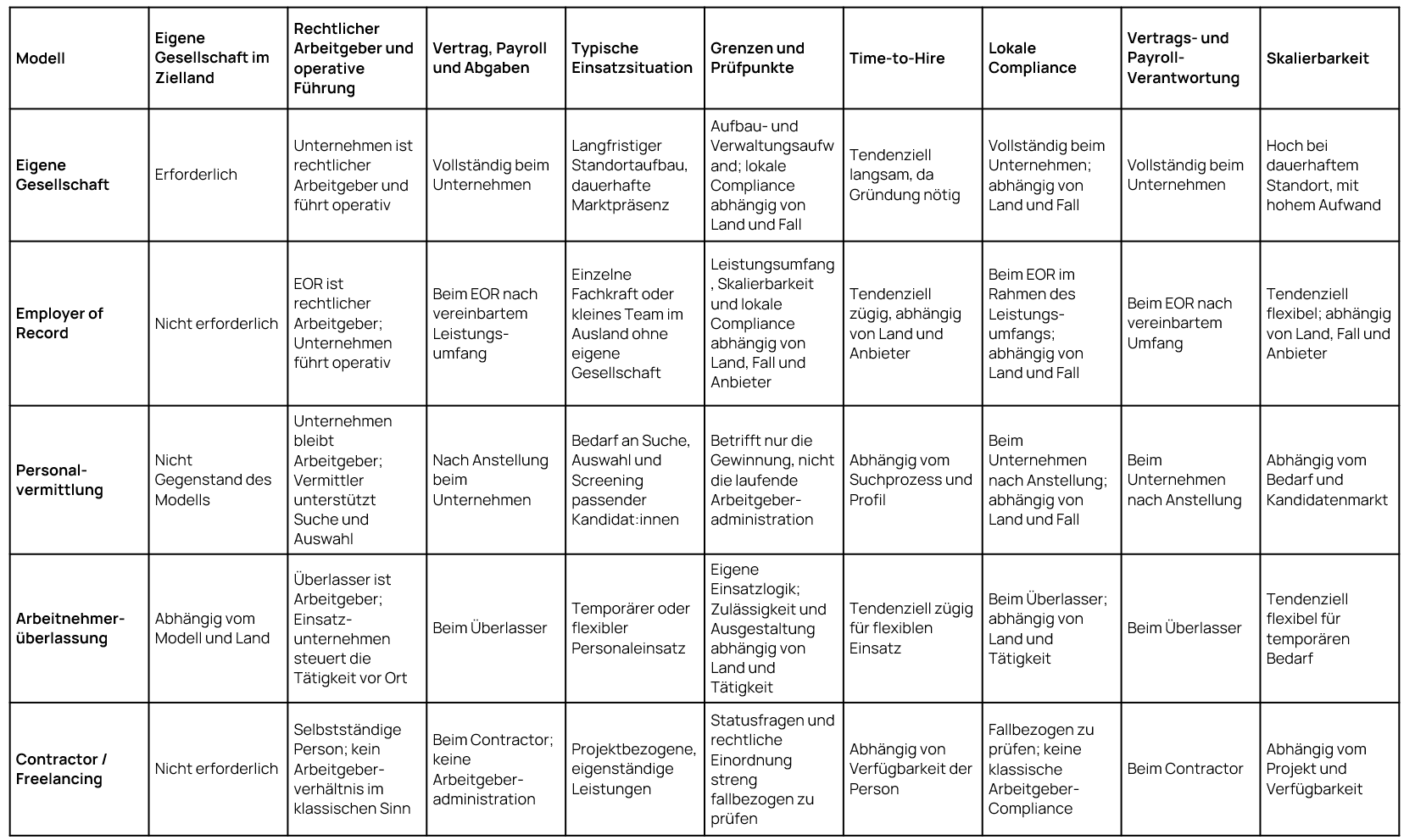
The criteria of time-to-hire, local compliance, contractual and payroll responsibility, and scalability are classified only qualitatively in the table. The actual assessment always depends on the country, the specific case, and the provider. For details on the option without establishing a separate company, see the article on nearshoring.
How collaboration with an EOR works
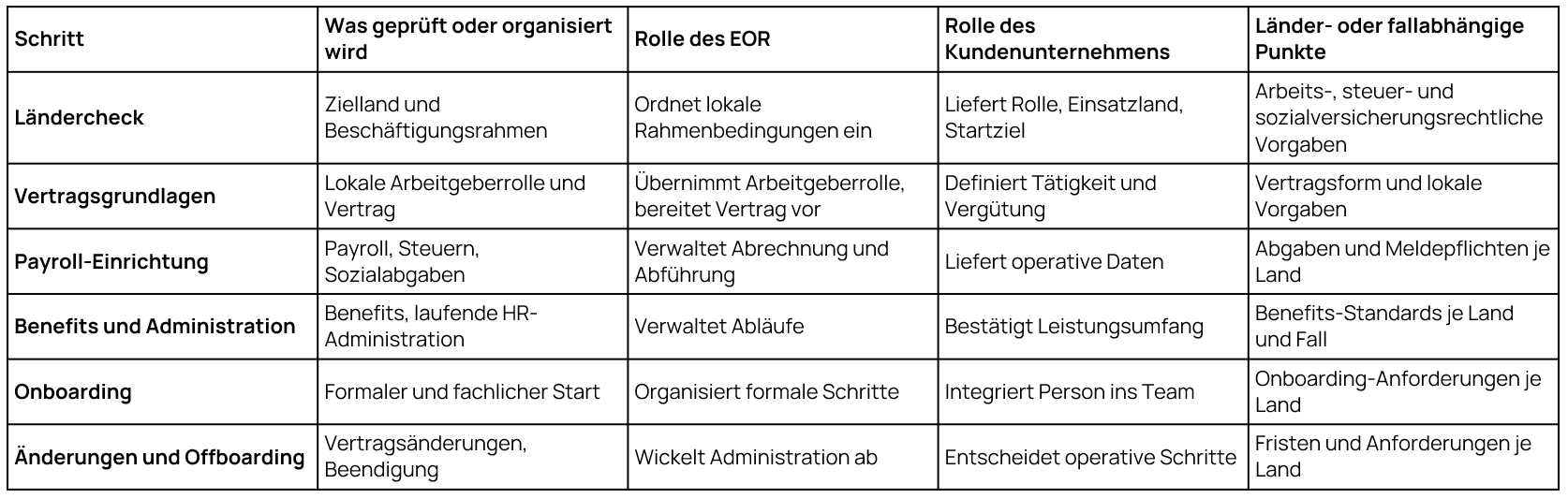
The collaboration follows a clear process. Each step outlines the purpose, responsibility, and a specific coordination point.
Review the target country: Establish the employment framework. The process begins with a country review. Labor, tax, and social security regulations must be taken into account depending on the employee’s country of origin and the deployment model. Your company provides the role, country of assignment, and initial objective; the EOR assesses the local framework conditions. The coordination point is the joint confirmation of the employment framework before proceeding to the next step. Early clarity here prevents later delays and creates a robust basis for planning. Details on the employer role can be found on the Employer of Record (EOR) page.
Define the employer role: Clarify the contractual framework. The EOR assumes the local employer role and prepares the contractual framework. Your company defines the job description, compensation framework, and form of employment, while the EOR is responsible for the contractual implementation in the target country. The key coordination point is your company’s approval of the draft contract. This ensures that it is clear from the outset which terms apply and who bears which obligations. This provides certainty for both parties before the employment relationship begins.
Set up payroll: Remit taxes and social security contributions in compliance with the law. The EOR manages payroll, tax withholding, and social security contributions, as well as compliance with local labor laws, while your company retains day-to-day management. You provide the operational data, such as working hours and variable components; the EOR ensures correct processing. The coordination point is the approval of the monthly payroll entries prior to processing. This approval ensures that payments are made correctly and on time and that taxes and contributions are remitted in compliance with the law.
Coordinating benefits: Organizing HR administration. Benefits and ongoing HR administration are defined based on the target country and scope of services. The EOR manages the processes; your company confirms the agreed-upon benefits. The coordination point is the approval of the scope of benefits and administration. This ensures transparency regarding which benefits are included in the package and which must be reviewed separately. This provides planning certainty for ongoing support.
Organizing onboarding: Getting everything ready to go. Onboarding is a critical planning phase. The EOR organizes the formal steps, while your company integrates the new hire into the team from a professional standpoint. The key coordination point is the alignment of onboarding responsibilities between the EOR and your company prior to the start date. This ensures that each party knows which tasks they are responsible for, and the new hire can start without any hiccups. Specific requirements vary by country and case.
Managing Changes: Handling Offboarding Smoothly. Contract changes and offboarding are managed in a structured manner. The EOR handles the administrative processing; your company decides on the operational steps. The key coordination point is reaching a mutual agreement on how to handle changes and the termination of the employment relationship. This agreement avoids ambiguities and ensures an orderly conclusion. Here, too, specific deadlines and requirements vary by country and case.
What Additional Services Trenkwalder Provides as an EOR
Trenkwalder is a partner for customized HR solutions with broad expertise across many industries and a clear focus on the individual needs of each company.
The EOR covers international employment. Recruiting may be a complementary need, but it is a separate service. Both areas are interrelated without being the same thing.
Tailored support for international staffing needs
As an EOR, Trenkwalder provides structure and planning certainty for international staffing needs. You receive transparent support that organizes administrative, legal, and tax-related tasks, while you retain operational management. The benefit lies not only in streamlining processes but also in providing clear guidance for HR and a transparent journey for employees.
Where technology plays a role, the focus is on precise matching: bringing the right people together with the right jobs. Data-driven matching aligns the requirements of a position with candidates’ profiles, thereby revealing suitable connections. It’s the result that counts, not the tool.
Strategically Combining EOR and Recruiting
If your company needs additional support with talent acquisition, recruiting can be integrated as a complementary approach. If needed, Trenkwalder handles the individual search, selection, and screening of suitable candidates, taking into account the position’s and company’s requirements.
For more complex needs, Recruiting Process Outsourcing (RPO) is a separate solution. RPO can encompass defined sub-processes or end-to-end recruitment—from job postings and applicant tracking to hiring and onboarding. This allows you to combine international employment and talent acquisition without mixing the services.
FAQ on Employer of Record
What does “Employer of Record” mean?
Employer of Record refers to a model in which an external provider acts as the legal employer for employees. The client company retains control over day-to-day tasks and management, while the EOR handles administrative, legal, and tax-related responsibilities. The exact scope of services depends on the target country and the agreed-upon framework.
Who is the legal employer in an EOR arrangement?
The legal employer is the EOR. It is formally named in the employment contract and bears the administrative, legal, and tax obligations in the respective country. The client company retains responsibility for the employee’s professional and operational management.
Which service providers help companies employ international employees in a legally compliant manner?
Depending on your needs, different types of service providers may be suitable. An EOR assumes the role of legal employer and handles employment administration. Recruiting or staffing agencies assist with the search and selection process; temporary staffing covers flexible workforce deployment according to the agency’s own deployment logic; and immigration and relocation consulting addresses residency and entry issues. Which type is appropriate depends on the destination country, the specific employment situation, and the desired employer role.
What are the costs associated with an Employer of Record?
The costs depend on the destination country, the specific employment situation, and the scope of services, which is why it’s not possible to provide flat-rate figures. When reviewing a quote, look for a transparent breakdown of the components: employer role, payroll, taxes, benefits, ongoing administration, onboarding, changes, and offboarding. This allows you to clearly compare and evaluate the quote.
In which countries is EOR possible?
Whether EOR is possible in a specific country depends on local employment regulations and the specific case. It is not possible to provide a universally applicable list of countries. It makes sense to conduct a preliminary review of the target country and the regulations that apply there.
What documents are required for EOR employment?
There is no definitive checklist because the requirements vary by country and case. Typical categories that should be reviewed include details regarding role, country of assignment, start date, compensation, and form of employment. The specific scope is determined as part of the country review.
What must a company review before engaging an EOR provider?
Before engaging an EOR, you should clarify the following points: destination country, role, duration of employment, management model, scope of services, cost model, and point of contact. This checklist establishes a common foundation for the proposal and subsequent collaboration. It helps identify specific needs early on and with precision.
Conclusion: International employment does not mean a loss of control, but rather clearly defined roles
The Employer of Record separates the legal responsibilities of an employer from operational management. This is precisely why it can be a suitable model for international employment: You continue to manage your team yourself, while administrative, legal, and tax-related tasks are handled in a structured manner.
Whether an EOR is suitable in a specific case depends on the target country, employment model, duration, staffing needs, and desired scope of services. There is no one-size-fits-all answer; rather, it requires a careful assessment based on your specific situation.
If you employ international staff or want to build a team in a new market, it’s best to clarify your needs in a structured manner. Trenkwalder supports you with tailored solutions as an Employer of Record (EOR). Contact us to discuss your specific international staffing needs.
Interested in more articles like this?
Sign up and get more articles on the topics of “Human Resources, Recruiting/Flex Employment”
This site is protected by reCAPTCHA Enterprise.
Social Media


Follow us for the latest
We constantly post new interesting job offers, tips and look for talent there.
Trenkwalder @